> You should read the CVs of the initial SpaceX team before SpaceX. Do with this info what you wish
find them for me
Found them—mostly. Only Hans Koenigsmann has a literal public CV; for the others, I reconstructed their pre-SpaceX résumés from NASA oral histories, university biographies, interviews, and an archived SpaceX leadership page.
NASA’s Tim Buzza described Musk, Tom Mueller, Chris Thompson, and—shortly afterward—Hans Koenigsmann as SpaceX’s “initial core.” Buzza and Gwynne Shotwell joined by August 2002, completing the earliest operating team. Employee numbers vary between accounts, so joining order shouldn’t be treated as exact.
| Person | Résumé before SpaceX |
|---|---|
| Elon Musk | Physics degree from Penn; business degree from Wharton; brief work in ultracapacitors and game software. Built Zip2, which Compaq acquired for $307M, then founded X.com, which became part of PayPal. Unlike the others, he had no professional aerospace experience—his contributions were capital, software/product instincts, recruiting, and technical self-education. Stanford profile |
| Tom Mueller — propulsion | BS Mechanical Engineering, University of Idaho; MS Mechanical Engineering, Loyola Marymount. Spent approximately 15 years at TRW, eventually running its liquid-propulsion work. Lead engineer on the 650,000-lbf TR-106 LOX/hydrogen engine. Independently built and flew large liquid-fuel amateur rockets, which is how Musk found him. Pre-SpaceX interview · résumé-style biography |
| Chris Thompson — structures and manufacturing | Marine Corps CH-53E helicopter crew chief; later McDonnell Douglas/Boeing. Managed production involving the Delta II, III and IV and Titan IV launch vehicles, worked launch operations at Cape Canaveral and Vandenberg, and ultimately led test and verification at Boeing’s Huntington Beach laboratories. Studied aerospace engineering at CSU Long Beach and held an aircraft-mechanic qualification. Archived SpaceX profile · contemporary Wired profile |
| Hans Koenigsmann — avionics, guidance and control | Aerospace diploma from TU Berlin; PhD from the University of Bremen. At ZARM from 1989–96, managed the space-systems division and designed BREMSAT’s attitude control, power storage and hardware-in-the-loop testing. At Microcosm from 1996–2002, served as chief scientist, built spacecraft-control algorithms, worked two suborbital vehicles through launch, and led GNC work for a lunar lander. Actual one-page CV PDF |
| Tim Buzza — testing and launch operations | BS and MS Mechanical Engineering, Penn State. Roughly 14 years at McDonnell Douglas/Boeing, spanning MD-11 and C-17 aircraft testing and Delta IV development. Immediately before SpaceX, he was test project manager for the Delta IV first stage, responsible for 23 major tests with a combined budget of about $100M. Archived SpaceX profile · NASA oral history |
| Gwynne Shotwell — customers and business operations | Honors BS Mechanical Engineering and MS Applied Mathematics from Northwestern. Briefly entered Chrysler’s management program, then spent ten years at The Aerospace Corporation doing thermal analysis, systems engineering and project management—including work as a satellite-program chief engineer and commercial-space studies for the FAA and NASA. In 1998 she joined Microcosm, eventually heading its space-systems division and business development. NASA biography · detailed Northwestern profile |
Proto-SpaceX member: Jim Cantrell
Cantrell helped Musk investigate Russian launch vehicles and worked on the venture before or around incorporation, serving as its initial business-development lead before leaving in 2002. His earlier CV was unusually international:
- BS/MS in aerospace and mechanical engineering, Utah State.
- JPL research engineer; co-invented the “Mars Snake” surface payload.
- CNES work on a joint French-Soviet Mars program.
- Space Dynamics Laboratory systems engineering and US–Russian missile-defence work.
- Program manager for the privately funded Cosmos 1 solar-sail mission.
What the CVs actually reveal
The five aerospace veterans surrounding Musk brought roughly 75 years of relevant experience before SpaceX. More importantly, their backgrounds fit together almost perfectly:
- Mueller: engines
- Thompson: structures and production
- Koenigsmann: avionics and control
- Buzza: testing and launch infrastructure
- Shotwell: systems, customers and contracts
- Musk: capital, software/startup execution and product direction
This wasn’t primarily a team of inexperienced prodigies. It was a deliberately assembled miniature launch company made from senior people who had already built and tested engines, rockets, satellites, aircraft and launch facilities—but who had been frustrated by the pace and organizational constraints of traditional aerospace. Their schools were also varied rather than uniformly prestigious; demonstrated subsystem ownership appears to have mattered more than pedigree.
> how did the team come together? how did elon find them? dig up the stories. cast a wide net
One correction to my earlier answer: Eric Berger’s detailed account places Shotwell’s start in September 2002, not August. Tim Buzza joined in August; the six-person leadership core was therefore in place by September.
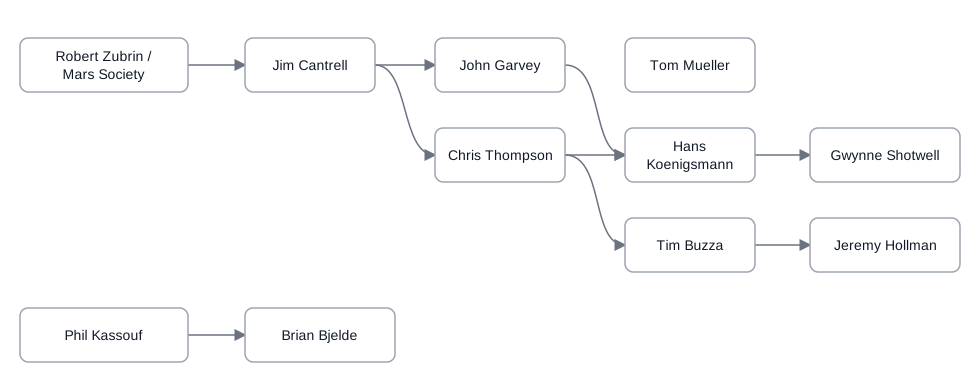
The early SpaceX team was assembled through a remarkably tight referral network—not conventional recruiting. One contact from the Mars Society led to a Russian-rocket expert, who led Musk into Southern California’s garage-rocketry scene, which connected him to Boeing, TRW, Microcosm, JPL and USC.
1. It started as a philanthropic stunt, not a rocket company
After PayPal, Musk investigated why NASA had no concrete plan for Mars. In 2001 he attended a Mars Society fundraiser and convention, met founder Robert Zubrin and briefly joined the society’s board. His initial concept—variously called Mars Oasis or Life to Mars—was to put a miniature greenhouse on Mars and broadcast plants growing there, hoping to reignite public interest.
At the Mars Society, Musk met or encountered two crucial connectors:
- Robert Zubrin, who knew practically everyone in the Mars-advocacy world.
- Michael Griffin, then a highly experienced aerospace executive and later NASA administrator.
Musk needed a cheap Russian launch vehicle. Zubrin directed him to Jim Cantrell, an engineer with extensive experience working in Russia and the former Soviet aerospace sector. WIRED’s account is based partly on interviews with Zubrin and Cantrell; the surviving 2001 convention report independently places Musk and Griffin at the event.
2. The cold call to Jim Cantrell
Cantrell was driving through Utah in July 2001 when an unknown caller introduced himself as an internet billionaire who wanted Russian rockets. With the convertible’s roof down, Cantrell reportedly thought the caller’s name was “Ian Musk.” When he returned the call, he initially reached a fax machine and suspected a prank.
Musk called back and offered to fly his private plane to Utah the next day.
Cantrell had never heard of Musk or PayPal, but agreed to meet. Musk pitched species survival, Mars and a demonstration mission. Cantrell became his aerospace guide: he lent Musk old college textbooks, helped develop Mars Oasis and introduced him to people who understood launch vehicles. Esquire’s detailed reconstruction and Cantrell’s Inc. interview tell substantially the same story.
3. Russia caused the decisive pivot
Musk, Cantrell, Griffin and—on some trips—Musk’s friend Adeo Ressi or wife Justine made repeated visits to Russia during late 2001 and early 2002. Sources disagree over whether to count these as two major delegations or three rounds of meetings.
The consistent elements are:
- Musk wanted refurbished ICBMs for Mars Oasis.
- Russian suppliers did not take the young internet entrepreneur seriously.
- Prices and terms kept changing.
- After the final rejection, Musk concluded that buying a rocket would not create sustainably cheap access to space.
On the flight back, Musk showed Cantrell and Griffin a spreadsheet estimating a rocket’s materials, mass, structure, engines and cost. Cantrell had thought the idea absurd, then realized Musk had been absorbing his textbooks and consulting engineers.
The famous airplane scene is probably somewhat compressed by repeated retelling, but Cantrell, Griffin and Musk all agree on the central point: the failed Russian negotiations changed the objective from buy a launch to build a launch company. Cantrell’s version is especially detailed.
Adeo Ressi remained skeptical. He reportedly gathered friends for an intervention intended to stop Musk from attempting the historically ruinous business of building rockets. Musk listened, thanked them and proceeded anyway. Esquire
4. Cantrell and John Garvey opened the garage-rocketry network
Cantrell says his main contribution during the proto-SpaceX period was using his industry network to find people. He pulled in Chris Thompson, a Boeing/McDonnell Douglas production and structures veteran.
Another early adviser was John Garvey, who had worked with Thompson and was building small liquid-fuel rockets in a Huntington Beach workshop. Garvey belonged to the Reaction Research Society, an amateur-rocketry organization whose members included professional aerospace engineers doing faster, stranger and less bureaucratic experiments on weekends.
Garvey helped Musk understand what a very small team could construct with ordinary machinery and limited money. He also gave Musk access to the Mojave rocketry community.
Garvey did not ultimately join SpaceX. Eric Berger’s account says he thought Musk’s approximately 1,000-pound-payload rocket was too ambitious and favored an even smaller design. But he was a critical bridge between Musk’s spreadsheet and people who had actually built engines and rockets.
5. Tom Mueller was found holding an 80-pound engine
In January 2002, Musk visited Garvey’s workshop and encountered Tom Mueller, TRW’s liquid-propulsion leader, installing an 80-pound amateur rocket engine.
Musk immediately began interrogating him:
- How powerful was this engine?
- What was the largest engine Mueller had developed?
- Could he build another one?
- How much would it cost?
- What people and equipment would he need?
Mueller’s professional answer was that TRW’s largest project produced roughly 650,000 pounds of thrust. His entrepreneurial answer was that, with the right team, he could build an engine for Musk.
Mueller’s own current recollection credits Chris Thompson with making the direct recommendation: Musk asked Thompson for an engine person; Thompson told him Mueller was the person. Other accounts emphasize Garvey, but these versions are compatible—the introduction came through the overlapping Thompson–Garvey–Reaction Research Society network. Mueller interview
The following Sunday, Musk went to Mueller’s house during the Super Bowl. Instead of watching much football, Musk, Mueller and other rocketeers worked through the engine concept that would become Merlin. They then met every week or two at hotels around Los Angeles International Airport. Mueller’s 2026 recollection
Mueller had previously considered other launch startups but rejected them because they lacked credible technology, capital or both. Musk offered all three things Mueller wanted:
- Funding large enough to build and test hardware.
- A deliberately simple rocket without a dubious technical gimmick.
- Ownership of the entire propulsion system.
A contemporary 2003 interview records Mueller saying that other ventures had relied on gimmicks, whereas Musk wanted established technology, a simple vehicle and suitable propellants. Los Angeles Times
6. Mueller and Thompson effectively crossed the bridge together
Through early 2002, Musk, Mueller, Thompson, Cantrell, Griffin, Garvey and other experts met over several Saturdays at an airport Hyatt. Musk asked how much launch costs could realistically fall. Mueller answered that a tenfold reduction might be possible if they avoided conventional government-contracting overhead. Contemporary Fast Company account
Musk eventually offered positions to five of the advisers. The usual accounting says:
- Michael Griffin: declined the chief-engineer role.
- John Garvey: declined.
- Jim Cantrell: did not accept a lasting operating position, although Cantrell says he served as VP of business development from December 2001 to September 2002.
- Tom Mueller: accepted.
- Chris Thompson: accepted.
Mueller went home, discussed it with his wife and signed. Thompson then called him to ask whether he was really doing it. When Mueller said he had already signed, Thompson signed too.
That paperwork accident made Mueller payroll employee No. 1 and Thompson No. 2; Mueller jokingly recalls Musk signing afterward and becoming No. 3. It is one reason SpaceX employee numbering is inconsistent across histories. Mueller’s account
Griffin’s refusal left the chief-engineer position vacant. Musk assumed it himself.
7. Hans Koenigsmann was a “double recommendation”
Musk briefly met Hans Koenigsmann at an amateur-rocket event in the Mojave Desert in early 2002. Koenigsmann, then chief scientist at Microcosm, invited Musk to visit the company. They discussed projects, and nothing happened for a month or two.
Behind the scenes, Musk then heard Koenigsmann’s name from two trusted sources:
- Chris Thompson.
- A contact at JPL.
Koenigsmann describes it as a double recommendation: Musk already recognized him from the Mojave handshake, and two engineers independently vouched for his avionics ability. Musk called and offered him responsibility for practically everything outside propulsion and structures—avionics, guidance, software, flight safety and control. Koenigsmann interview transcript
The pitch that won him over was unusually concrete. Koenigsmann had spent years working on technically interesting projects while also chasing funding. Musk was offering enough committed capital for several launch attempts and telling him to build.
Koenigsmann joined in May 2002. In a NASA oral history, he remembered the sequence simply: a launch-site meeting, a company visit, silence, then Musk’s call. NASA oral history
8. Chris Thompson brought Tim Buzza from Boeing
Once propulsion, structures and avionics had leaders, the obvious missing function was testing.
Thompson called Tim Buzza, with whom he had worked at Boeing’s Huntington Beach operation. Buzza had managed major Delta IV first-stage testing and knew how to turn a design into tanks, engine tests, structural tests and eventually a launch site.
Buzza joined in August 2002 as employee No. 5. His NASA oral history explicitly identifies Thompson, Mueller, Musk and then Koenigsmann as the original technical core, describing himself as the first close “second-wave” leadership hire. NASA’s Tim Buzza transcript
This was not merely résumé matching. Thompson already knew how Buzza behaved when hardware, budgets and schedules collided. Musk was acquiring trusted working relationships, not isolated stars.
9. Hans accidentally recruited Gwynne Shotwell
This is the most serendipitous hire.
After Koenigsmann left Microcosm, his former colleague Gwynne Shotwell took him to lunch to celebrate. Afterward, she drove him back to SpaceX’s nearly empty El Segundo building. Koenigsmann invited her inside to meet Musk.
The meeting lasted approximately ten minutes. Musk explained:
- Why launch costs were structurally too high.
- Why SpaceX would build its own engine.
- Why key systems should remain in-house.
- Why the industry needed faster execution.
Shotwell found him “scary, but compelling.” She casually remarked that if SpaceX intended to sell Falcon 1 launches, someone should work on sales full-time.
Later that day, Musk created the position and asked her to apply.
Shotwell initially resisted. She had two young children, was going through a divorce and had already built Microcosm’s space business substantially. Joining an unproven rocket startup was not an obviously rational choice. After several weeks, she concluded that she could either remain in the industry as it was or help push it toward Musk’s model.
She joined in September 2002. Eric Berger’s detailed WIRED excerpt
10. The referral machine continued below the leadership level
Once the subsystem leaders were in place, they repeated the same pattern.
Jeremy Hollman: Buzza recruited a young Boeing test engineer he had worked beside and trusted. Hollman joined in September 2002 and became Mueller’s propulsion lieutenant, effectively receiving an intensive apprenticeship in liquid-rocket engines. Bloomberg’s early-SpaceX reconstruction
Brian Bjelde: USC classmate Phil Kassouf invited Bjelde—then working at JPL—for what Bjelde thought was a casual factory tour. The questions became increasingly technical until he realized it was a job interview. Kassouf had personally vouched that Bjelde could handle all-nighters and difficult engineering problems. He became employee No. 14 in August 2003. Authorized Liftoff excerpt
By 2005, Musk and the technical vice presidents still interviewed every candidate, with each interviewer holding veto power. Later accounts say Musk personally approved roughly the first 3,000 employees. Fast Company · Eric Berger interview
Why these people actually said yes
Musk’s recruitment formula had six parts:
-
Trusted referrals: Almost every crucial hire arrived through someone whose technical judgment Musk had already tested.
-
Deliberate geography: SpaceX settled in El Segundo because TRW, Boeing, McDonnell Douglas, Microcosm, Aerospace Corp., JPL and their suppliers created a dense talent pool.
-
Credible personal capital: Musk was willing to risk approximately $100 million. Early hires received equity and, in some cases, guaranteed money—important because private launch startups had repeatedly collapsed.
-
Technical seriousness: Candidates expected a bored internet millionaire. Instead, they encountered someone who had read their textbooks, built detailed cost models and asked increasingly specific questions.
-
Unusually large ownership: At Boeing or TRW, an engineer might control a narrow portion of a decades-long program. At SpaceX, Mueller owned propulsion, Thompson structures, Koenigsmann avionics, Buzza testing and Shotwell the market.
-
Experienced but still malleable leaders: Koenigsmann says Musk deliberately hired mid-career people who knew how to build aerospace hardware but remained willing to discard established aerospace processes.
The shortest accurate version is:
Zubrin gave Musk the first phone number. Cantrell and Garvey opened the Southern California rocket network. Thompson became the central recruiting node. Mueller supplied the engine, Koenigsmann the flight brain, Buzza the test discipline, and Koenigsmann’s lunch friendship brought in Shotwell. Musk supplied the capital, urgency and a mission large enough to persuade them to leave safe careers.